The Exception Butterfly
The Maybe and Either types may be Haskell’s most notable contribution to computer science, inspiring similar structures in Rust, C++, JavaScript, Python, and other languages. These types not only upgrade the usual concept of null, but they also include composable machinery to make dealing with potentially missing data or failing computations ergonomic and informed by the compiler. These machines come with a cost, however, and oftentimes the resulting code (even with their monadic goodness) can be difficult to reason about. It echoes “Callback Hell” in early JS days before Promises existed.
Thankfully, there are a lot of extra tools we can use to make working with these types much easier. When used correctly, code involving potentially missing fields, errors, and even nested computations should read like a procedural program and still maintain all of the guarantees of Haskell’s strong typing. I’m creating this post to share what I’ve found on my journey of using Haskell over the past three years.
Mixing Maybe and Either
Maybe already contains within it the machinery to chain value dependencies in a readable and ergonomic fashion:
mTitle :: Maybe Text
mDescription :: Maybe Text
mAuthor :: Maybe Person

book :: Maybe Book
book = do
  title <- mTitle
  description <- mDescription
  author <- mAuthor

  pure $ Book {..}
When we wish to upgrade a Maybe to an Either, however, things can start to become harder to follow. Typically, you want to start using Either when you wish to annotate the reason for the failure (after all, Either is semantically compatible with Maybe, it just adds a value for the Nothing branch).
data BookError
  = NoTitle
  | NoDescription
  | NoAuthor

book :: Either BookError Book
book = do
  title <- case mTitle of
    Just title -> pure title
    Nothing -> Left NoTitle
  description <- case mDescription of
    Just description -> pure description
    Nothing -> Left NoDescription
  author <- case mAuthor of
    Just author -> pure author
    Nothing -> Left NoAuthor

  pure $ Book {..}
There is actually a nice library method for this in Control.Error.Util called note that lets you tag the Nothing branch and promote the Maybe into an Either:
book :: Either BookError Book
book = do
  title <- note NoTitle mTitle
  description <- note NoDescription mDescription
  author <- note NoAuthor mAuthor

  pure $ Book {..}
Sometimes this is also called maybeToEither, but I prefer the terser note.
Transformers
Maybe and Either do not support enough functionality to make practical programming in Haskell ergonomic. All Haskell programs operate inside of the IO monad, even if you can produce plenty of methods that operate on types like Maybe independently (which is often a good idea anyways to increase ease of testing). Still, you can’t avoid operating inside of IO as that is where you can do network requests, database operations, and all side-effects. Dealing with types like IO (Maybe a) is often unavoidable, and produces some new challenges. IO and Maybe both have their own monadic behavior, and yet do blocks only support using one at a time. Things can get hairy.
getTitle :: IO (Maybe Text)
getDescription :: IO (Maybe Text)
getAuthor :: IO (Maybe Person)

getBook :: IO (Either BookError Book)
getBook = do
  mTitle <- getTitle
  mDescription <- getDescription
  mAuthor <- getAuthor

  pure $ do
    title <- note NoTitle mTitle
    description <- note NoDescription mDescription
    author <- note NoAuthor mAuthor

    pure $ Book {..}
Transformers are built specifically to solve this problem for a grab-bag of monads. Conceptually, they let you “lift” operations of the outer monad into an upgraded one that has your nested type, along with a set of methods to make operating with the nested monad as easy as Maybe and Either when they are not nested.
getTitle :: IO (Maybe Text)
getDescription :: IO (Maybe Text)
getAuthor :: IO (Maybe Person)

getBook :: IO (Maybe Book)
getBook = runMaybeT $ do
  title <- MaybeT $ getTitle
  description <- MaybeT $ getDescription
  author <- MaybeT $ getAuthor

  pure $ Book {..}
Magic! Under the hood, this is just a newtype that represents the nested monads (in this case IO (Maybe a)). These transformers are abstract, but the outer monad is typically something derivative of IO and the inner monad is usually Maybe or Either. Sometimes you’ll see ListT, but it has been more rare in my experience. Without getting into the weeds, these concepts all serve one common purpose “make dealing with potentially absent values inside of IO easy”.
-- From the standard library:
newtype MaybeT m a = MaybeT { runMaybeT :: m (Maybe a) }
newtype ExceptT e m a = ExceptT (m (Either e a))

class MonadTrans t where
    -- | Lift a computation from the argument monad to the constructed monad.
    lift :: (Monad m) => m a -> t m a
Along with the newtype constructor/runner MaybeT/runMaybeT, there are also convenience functions. lift allows you to take something like IO a and turn it into a MaybeT IO a (which just wraps the result in Just under the hood). hoistMaybe allows you to take a Maybe a value and bring it into MaybeT IO a as well. Again, I’m using IO a lot here but the outer monad can really be anything. There is also ExceptT, which is very similar to the above example except it just uses Either instead of Maybe. The naming is unfortunate, as ExceptT has nothing to do with runtime exceptions. ExceptT also supports lift (all transformers must), as well as a similar hoistEither that parallels hoistMaybe.
Mixing Transformers
This is where transformers alone have not done as good of a job with making code easy to write and easy to follow. Still, there are some nice utility functions akin to equivalents in the non-nested case that can clean things up nicely. Say you have the following control flow:
getTitle :: IO (Maybe Text)
getDescription :: IO (Maybe Text)

-- Author here is now nested Either
-- Pretend BookError now includes an ApiError
getAuthor :: IO (Either BookError Person)

getBook :: IO (Either BookError Book)
getBook = runExceptT $ do
  mTitle <- lift getTitle
  mDescription <- lift getDescription

  author <- ExceptT $ getAuthor

  -- throwError uses MonadError to produce
  -- ExceptT (conceptually similar to Left)
  case mTitle of
    Nothing -> throwError NoTitle
    Just title -> case mDescription of
      Nothing -> throwError NoDescription
      Just description -> pure $ Book {..}
This is a toy example, but you can see things are starting to get unruly. In production code this can explode to a few hundred lines of nesting with sometimes up to four levels. How can we make this better? We can start by using noteT which is the transformer equivalent of note which we already encountered. There’s a slight problem, though. note was pretty convenient in that it was a standalone method that upgraded a Maybe into an Either, but noteT requires a MaybeT not an IO (Maybe a). It’s a bit more awkward, but we can nest the newtype constructor and noteT to clean up our code:
getBook :: IO (Either BookError Book)
getBook = runExceptT $ do
  mTitle <- noteT NoTitle $ MaybeT getTitle
  mDescription <- noteT NoDescription $ MaybeT getDescription
  author <- ExceptT $ getAuthor

  pure $ Book {..}
A Missing Method
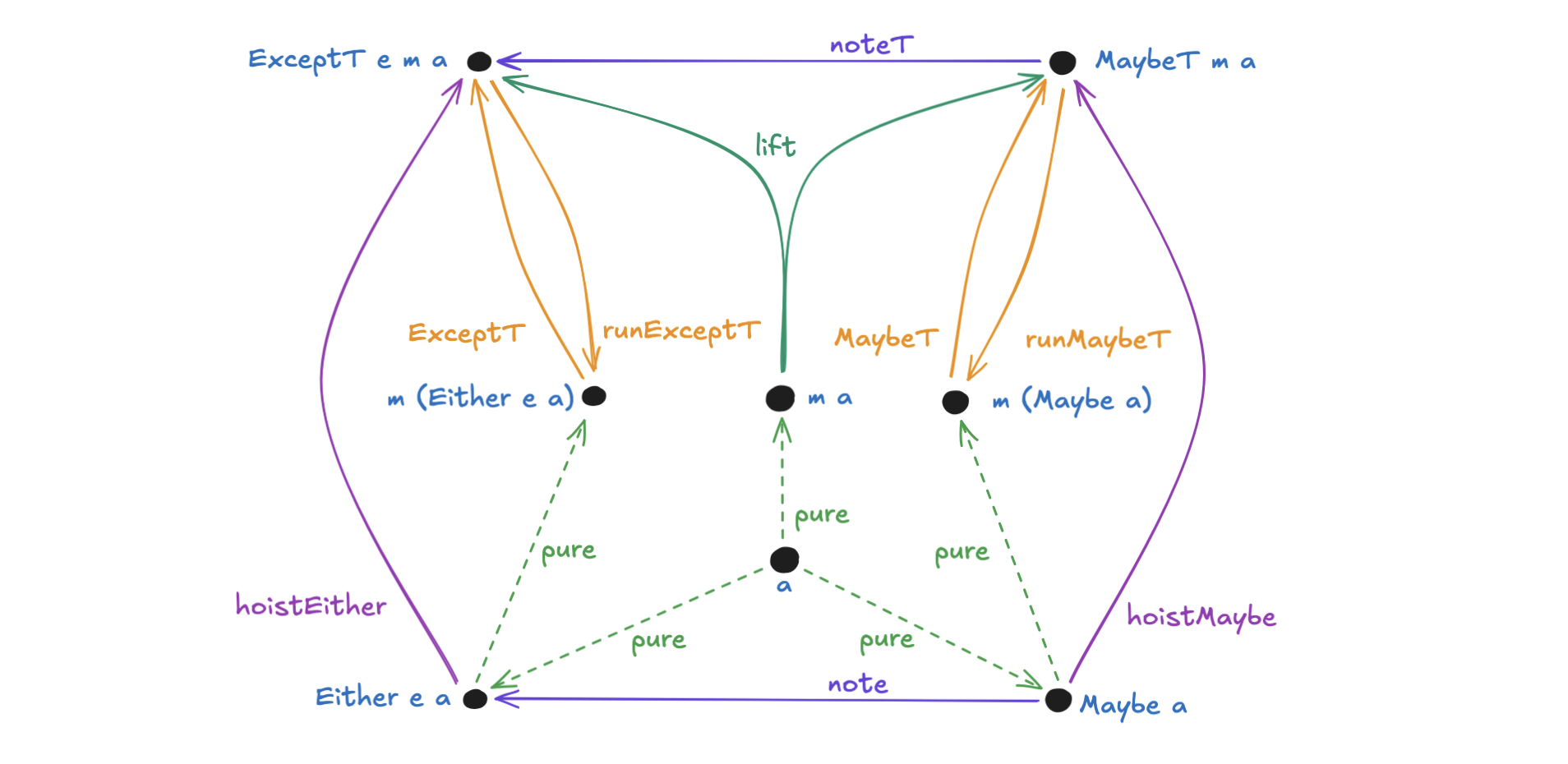
Compared to much of Haskell, Monad Transformers have a lot of methods to memorize and keep track of. When do you lift vs. hoist? How do I promote a value into the current transformer? The intuition comes with time and use of these patterns in your code, but a diagram can be helpful. It turns out there’s actually a really wonderful symmetry for these operations that I call “The Exception Butterfly”:
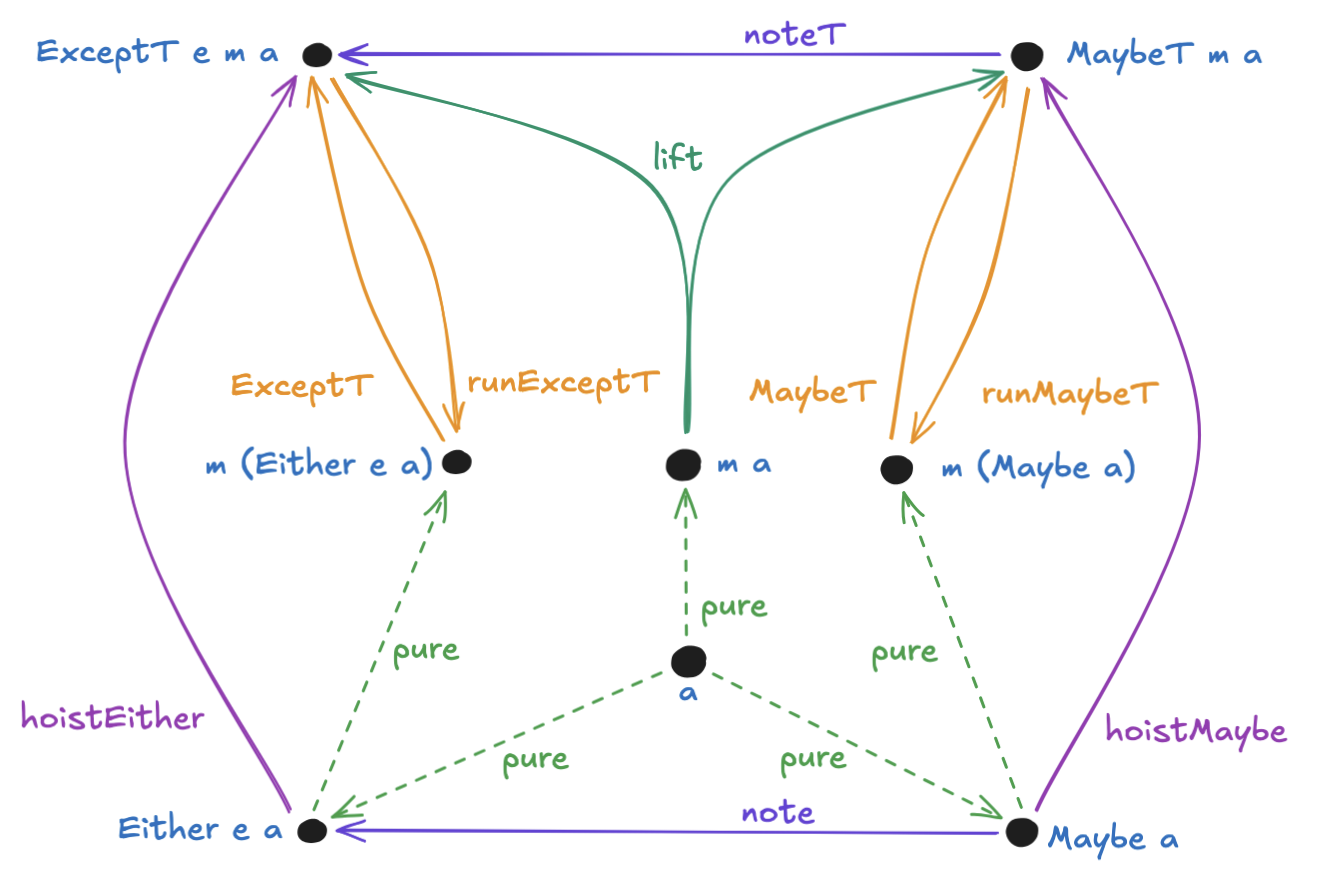
I wish I saw this a lot earlier on in my Haskell journey. There are a lot of moving pieces here, but the symmetry helps a lot and explains how (once you get to know them) these operations are not that hard to put into practice. Granted, what about the operation we just used to improve the code in the last example? You’ll notice that there is no arrow from m (Maybe a) to ExceptT e m a, unless you count the composition of MaybeT with noteT (which is what we did).
As I have written more and more Haskell, that is the arrow I have been missing the most. Perhaps avoiding yet-another-function is defending the Fairbairn Threshold of Haskell, but it’s so common that I am always reaching for it and so I’m going to give it a name here: annotateT. It is like an upgraded version of noteT that also lifts.
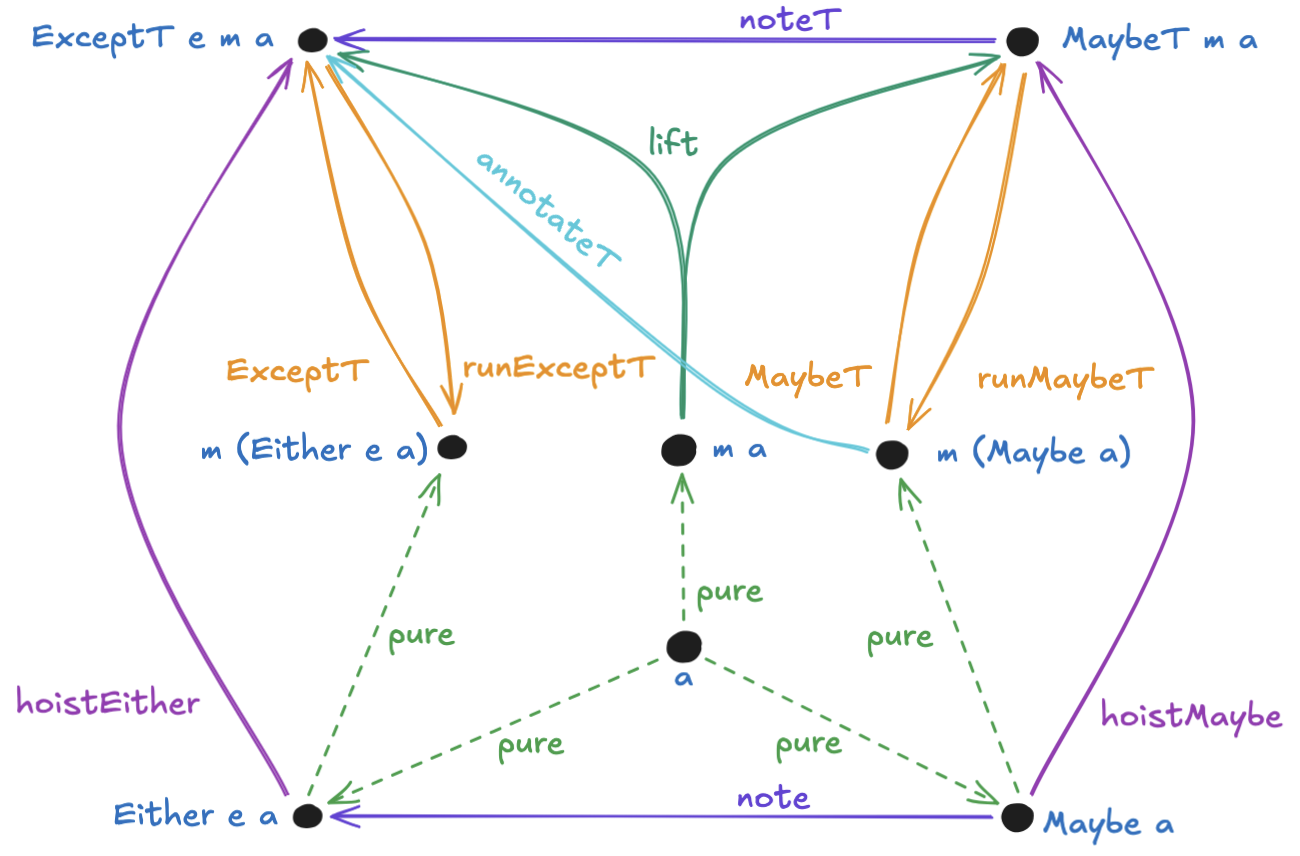
annotateT e = (noteT e) . MaybeTEven if you don’t have a named method, know that you can compose operations to transform values whenever you need it. Follow arrows on the diagram and compose as you go.

This work is licensed under a Creative Commons Attribution-NonCommercial-ShareAlike 4.0 International License.